
Laravelnote | What is Server Events Panel in Laravel forge in laravel8

Laravelnote in server event panel in laravel forge

 Claudio's first contribution to Forge is the addition of a new Server Events panel. This panel displays the last 30 days of server events, such as adding an SSH key, creating a new site, installing a new version of PHP, etc. It also doubles as an server audit trail, allowing you to see who did what, and when.
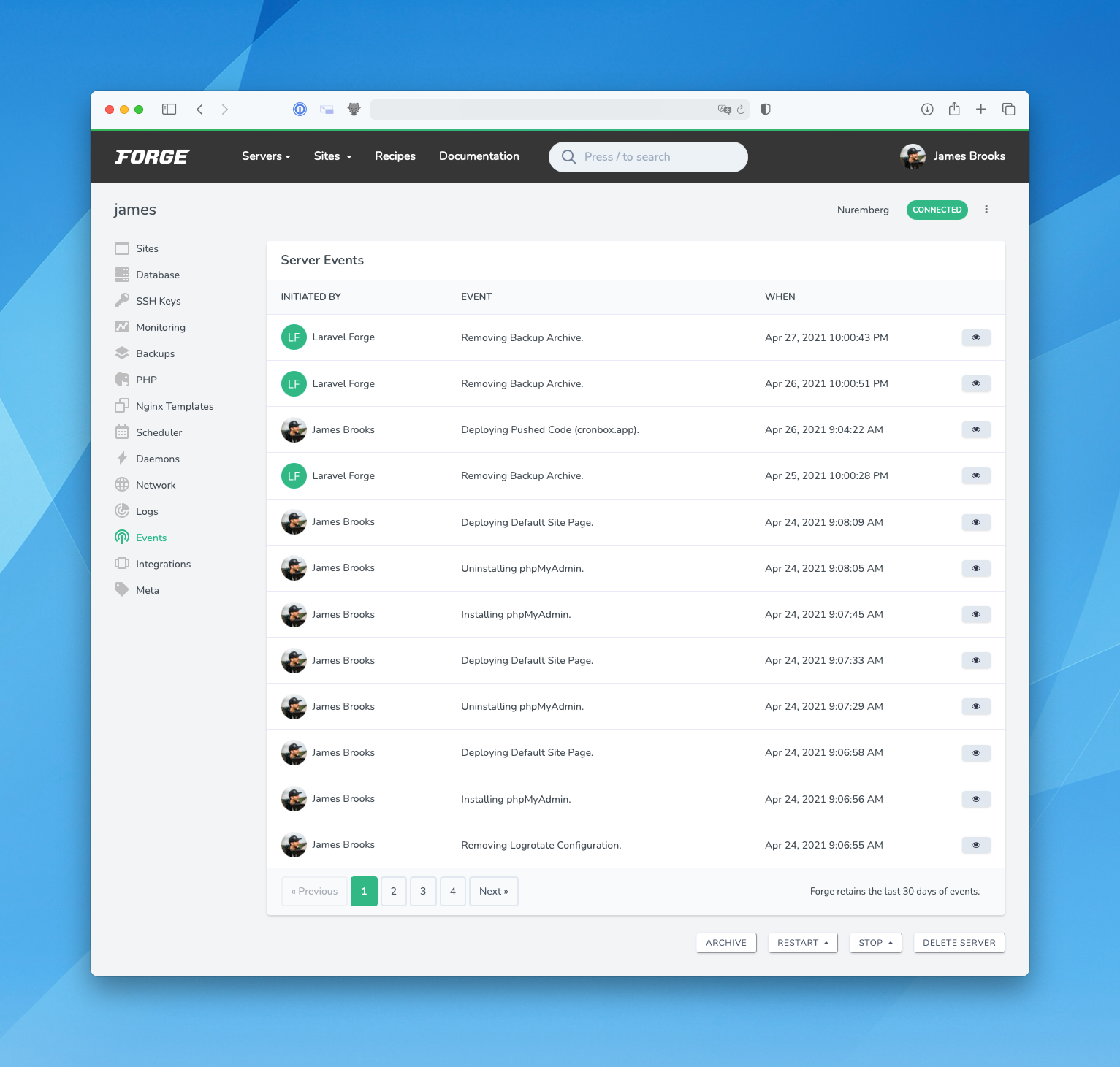
laravelnote spf
Laravel Server Panel forge

Popular posts from this blog

Composer Security Update (CVE-2021-29472) for leravel #2021

Composer had a security vulnerability reported (CVE-2021-29472) and a new version has been released to address this. Everyone should run  composer self-update  to get v2.0.13 which includes the fix. According to their  announcment : As a precaution after updating Composer we recommend you audit your composer.lock files to ensure they only contain URLs and none which start with -- , e.g. --config and could be considered command line options. Should you find any such URL values despite our belief that this vulnerability was not exploited in the wild, please contact us immediately by email to security@packagist.org. In general we always recommend you review changes you make to your lock files to ensure no untrusted dependencies or external URLs are introduced to your application. Please note that Packagist.org is only a metadata server and package contents are downloaded from a location chosen by the package maintainers. Private Packagist will store copies of mirrored packag...

Laravel8 in Serializes Models trait | laravelnote

This article was originally posted, with additional formatting, on my personal blog at laravel serializes model Background  When dispatching an object onto the queue, behind the scenes Laravel is recursively serializing the object and all of its properties into a string representation that is then written to the queue. There it awaits a queue worker to retrieve it from the queue and unserialize it back into a PHP object (Phew!). Problem When complicated objects are serialized, their string representations can be atrociously long, taking up unnecessary resources both on the queue and application servers. Solution Because of this, Laravel offers a trait called SerializesModels which, when added to an object, finds any properties of type Model or Eloquent\Collection during serialization and replaces them with a plain-old-PHP-object (POPO) known as a ModelIdentifier. These identifier objects represent the original properties Model type and ID, or IDs in the case of an Eloquent\Collecti...

Password Validation Rule Object in laravel8 by laravelnote

  Originally released in Laravel 5.5,   custom validation rule objects   offer a fluent alternative to string-based rules. In its simplest form, the   Password   rule object replaces string-based validation rules: <?php // String-based $request->validate([ 'password' => 'required|string|confirmed|min:8', ]); // Using the Password rule object $request->validate([ 'password' => ['required', 'confirmed', Password::min(8)], ]); In addition to replacing string rules with a fluent password rule object, the custom password rule object includes built-in methods for ensuring strong passwords: <?php $request->validate([ 'password' => [ 'required', 'confirmed', Password::min(8) ->mixedCase() ->letters() ->numbers() ->symbols() ->uncompromised(), ], ]); Never write custom regex logic for typical...